

Article: Where Design Meets Tea Ceremony: Innovating Tradition for the World — Interview with Prof. Toshiro Tamada (Part 2)
Where Design Meets Tea Ceremony: Innovating Tradition for the World — Interview with Prof. Toshiro Tamada (Part 2)
Today, "Matcha" is capturing significant global attention. At the forefront of modern design management, Prof. Toshiro Tamada (Professor Emeritus at Tokyo Zokei University) has long hosted creative tea ceremonies both in Japan and internationally.
We spoke with Prof. Tamada, who thoughtfully incorporates ISSO TEA's "Ceremonial Grade Matcha" into his own tea gatherings.
While remaining at the leading edge of contemporary design management, he continuously explores the deep essence of tea. In this interview, he shares his unique perspective—the reality behind the global matcha trend, the intellectual playfulness of reinterpreting spaces ("mitate"), and why we seek authentic, tangible experiences in modern life.
We are pleased to present this three-part series exploring the rich spirituality of the Way of Tea and its profound connection to design.

The Intellectual Playfulness of "Mitate" — Merging Tradition and Innovation
Prof. Ula Mach-Bryson of Poland: A Deep Understanding of Tea Culture
ISSO: The high-context spirituality embedded in the tea ceremony—such as concepts of "Kiyome" (purification) and "Kekkai" (sacred boundaries)—can be quite subtle. Do you find that people overseas, coming from different cultural and linguistic backgrounds, truly connect with these ideas?
Prof. Tamada: In short, if you approach the practice with genuine sincerity, people can grasp it just as deeply as anyone in Japan, regardless of where they were born and raised. My experience in Poland made me realize this powerfully.
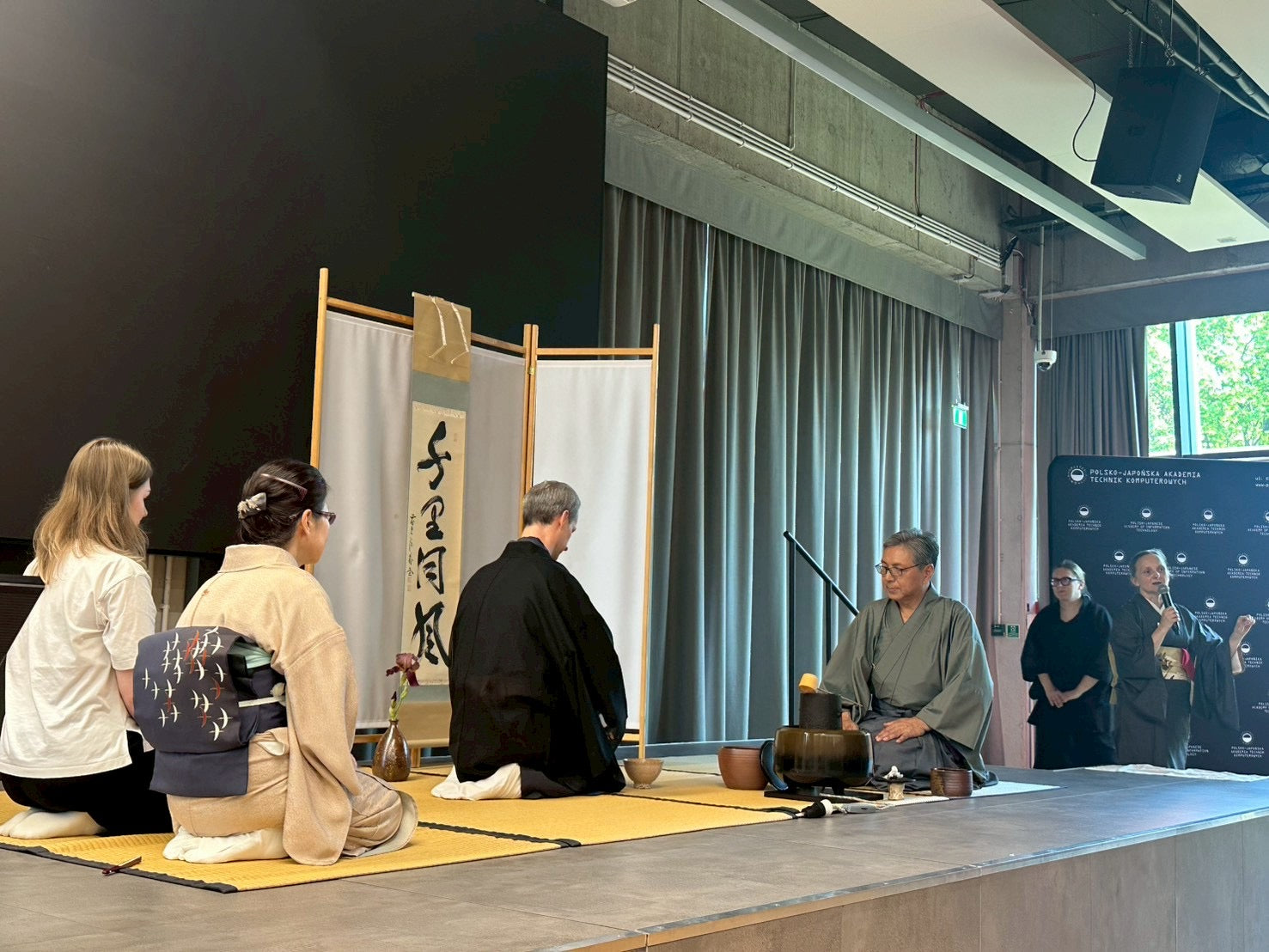
At the University of Warsaw, the Department of Japanese Studies offers a comprehensive program on Japanese culture, complete with an authentic tea room named "Kaian." The tea instruction there is led by Prof. Ula Mach-Bryson, a Polish scholar.
She is not only fluent in Japanese, but also a seasoned practitioner who has studied the Urasenke school for over twenty to thirty years. Observing her local students’ refined movements and heartfelt attitude toward tea was deeply moving—it proved to me that when practiced authentically in a proper environment, the true spirit of tea can resonate anywhere in the world.

Creating a Tea Room with Finnish Textiles
ISSO: You have hosted tea gatherings in countries like Finland, Sweden, and Germany. How do you construct tea spaces when working abroad?
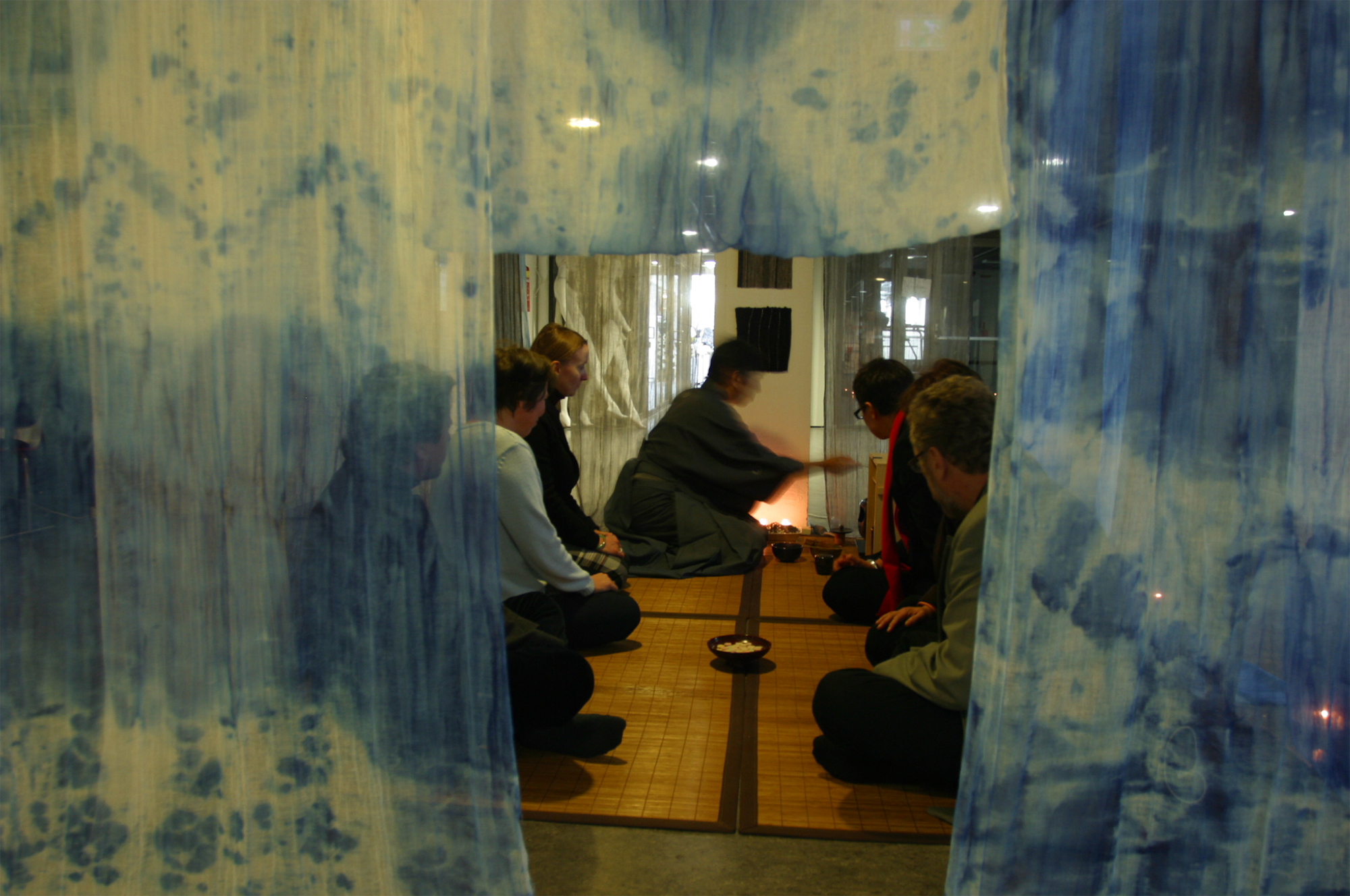
Prof. Tamada: Overseas, fixed tea rooms rarely exist, so I leverage local materials and environments to perform "Mitate"—reimagining and transforming the space at hand into a tea venue.
In Finland, for instance—a country renowned for its rich textile culture—we hung elegant local fabrics from the ceiling to enclose the space and create a temporary tea room. In a university auditorium in Germany, we laid down paper tatami mats and crafted a "Roji" (dewy garden path) out of paper. In Sweden, inside a historic building near the Nobel Prize Museum, we assembled a portable, collapsible tea structure made of wood and shoji paper brought from Japan.


ISSO: I understand you also host highly creative conceptual tea gatherings across Japan as well.
Prof. Tamada: Yes. Rather than repeating the exact same format everywhere, I find delight in crafting unique themes inspired by the distinct history and characteristics of each location.
For example, when hosting a tea ceremony at gallery sana village in Taki Town, Mie Prefecture, we used a space known as the "Cinnabar Room." Cinnabar is a rare red mineral (pigment) composed of mercury sulfide.

In ancient Japan, cinnabar was revered as a symbol of eternity—found, for instance, spread around the serpentine sword (Dakoken) unearthed at the Tomio Maruyama Tumulus in Nara, or painted on ancient burial mound walls. It carries immense historical significance as a sacred red pigment.
For that ceremony, we printed stone imagery onto carpet tiles to cover the floor, creating a creative space fused with the solemn, sacred atmosphere of cinnabar red.
While traditional tea rooms have their own undeniable grace, harnessing the unique context of a specific setting allows us to share an incomparably rich and memorable experience.

ISSO: So you actively manifest unique, temporary spaces tailored to local culture and surroundings?
Prof. Tamada: Exactly. One of the greatest virtues of the tea ceremony is its mobility—the host’s vision can manifest a tea space anywhere.
Even Sen no Rikyu designed the "Tabi-dansu" (portable travel cabinet) so samurai could compactly carry a complete set of tea utensils when departing for distant battles. Facing the constant threat of death, samurai would quiet their minds and prepare for battle over what might be their very last bowl of tea.
Historically, tea culture originally centered around displaying prestige through rare, expensive imported celadon and white porcelain.
Yet Rikyu and his contemporaries shattered that paradigm, declaring that supreme beauty could be found in rustic, humble items—like unglazed ceramics or distorted Raku tea bowls.
It is precisely because of this radical spirit of innovation that the Way of Tea has remained vibrant and creative for over 400 years without ever growing stale.

Oyster Shell Karesansui and Glowing Blue LEDs
ISSO: While honoring traditions, your tea gatherings incorporate noticeably avant-garde ideas.
Prof. Tamada: Rather than adhering strictly to rigid forms, I derive great joy from establishing unique themes that draw out local character. For a tea ceremony in Toba, Mie Prefecture—a region famous for its oysters—we had oyster shells brought in. We created a "Karesansui" (dry landscape garden) by spreading sand over square wooden trays I crafted myself, arranging the shells and embedding small, soft blue LED lights inside them.

People sometimes ask me, "Do grand masters or traditional authorities criticize you for taking such bold artistic liberties?" In truth, grand masters and traditional leaders never reject these adventurous attempts; instead, they appreciate them deeply.
This acceptance exists because the spirit of innovation lies at the very heart of this long-standing tradition.

"Floating Thatched Boat Tea Room" — Named by Toshiro Tamada / Photo by Katsuhito Nakazato
(To be continued)
Toshiro Tamada
Born in Fukushima Prefecture in 1957.
Graduated from Tokyo Zokei University (Department of Design) and completed his Master's degree in Industrial Design at the Graduate School of Art and Design, University of Tsukuba.
After working at the Tokyo Metropolitan Industrial Technology Research Institute, serving as an Associate Professor at Tohoku University of Art & Design, and as a Visiting Professor at the University of Art and Design Helsinki (now Aalto University), he joined Tokyo Zokei University in 2006. His fields of expertise are Industrial Design and Design Management, actively leading regional industry production and design research and development.
He served as Vice President of Tokyo Zokei University from 2014 to 2018 and was named Professor Emeritus in 2023. In 2020, he founded the Japan Design Management Association (JDMA) and serves as its Representative Director.
He is also an Associate Professor in the Omotesenke Domonkai tea school, holding the tea name Tamada Soshun.
His publication credits include Regional Design: Lessons from the 'Climats' of Burgundy, France (Co-authored / Gendaikikakushitsu, 2018), ICONIC WORLD (Tohoshuppan, 2020), Indicators of Design Management and the Founding of the Japan Design Management Association (The Industrial Craft Foundation / Japan Crafts & Technology Association, 2023), 7 Indicators of Design Management: DESIGN DYNAMISM (Japan Design Management Association), and A Journey Through Ancient Visual Culture: Primitive Landscapes and Icons of Faith (Text by Toshiro Tamada, Photography by Kazuto Nakazato and Mao Matsuda / FUIGOLAND LLC, Sold by JDMA, 2024; collected in the Miwayama Library of Omiwa Shrine).
%20has%20long%20hosted%20creative...)