

Article: Where Design Meets Tea Ceremony: Innovating Tradition for the World — Interview with Prof. Toshiro Tamada (Part 1)
Where Design Meets Tea Ceremony: Innovating Tradition for the World — Interview with Prof. Toshiro Tamada (Part 1)
Today, "Matcha" is capturing significant global attention. At the forefront of modern design management, Prof. Toshiro Tamada (Professor Emeritus at Tokyo Zokei University) has long hosted creative tea ceremonies both in Japan and internationally.
We spoke with Prof. Tamada, who thoughtfully incorporates ISSO TEA's "Ceremonial Grade Matcha" into his own tea gatherings.
While remaining at the leading edge of contemporary design management, he continuously explores the deep essence of tea. In this interview, he shares his unique perspective—the reality behind the global matcha trend, the intellectual playfulness of reinterpreting spaces ("mitate"), and why we seek authentic, tangible experiences in modern life.
We are pleased to present this three-part series exploring the rich spirituality of the Way of Tea and its profound connection to design.

An Encounter with Tea Culture: Sparked by an International Student
"Please Introduce Japanese Culture to Us"
ISSO TEA (ISSO): Prof. Tamada, thank you very much for taking the time to speak with us today. To begin, could you share how your journey in design led you to the world of the Way of Tea?
Prof. Toshiro Tamada (Tamada): My background is in industrial design research and education, and I taught at art universities in Japan and abroad for many years. Currently, I founded the "Japan Design Management Association" and actively promote design practice.
My relationship with tea culture actually began during my graduate studies at the University of Tsukuba. At the time, there were many international students in my program, and we became close friends. One day, a friend asked me: "Could you introduce Japanese culture to us?" At that moment, I realized I didn't deeply understand my own heritage and thought, "This won't do at all" (laughs).
There happened to be a dedicated building called the "Chado Kaikan" (Tea Ceremony Hall) on campus, so I stepped inside thinking I might learn something there. That was how I began practicing Urasenke-style tea ceremony alongside other students.

Tea gathering in Kanazawa
ISSO: Among various traditional arts like flower arrangement (Kado) or calligraphy (Shodo), why did you choose tea culture?
Tamada: The Way of Tea is not merely the act of drinking tea—it is a "comprehensive art form" (Gesamtkunstwerk) where every element is meticulously composed, from the spatial arrangement and vessel design to the sweets and etiquette of hospitality. I felt a strong personal fascination with it because it connected deeply with my own discipline of industrial design.
After finishing graduate school, I wanted to continue practicing tea even after entering the workforce. Through a fortunate connection, I began studying under a master of the Omotesenke school, which brings me to where I am today.
People often ask about the differences between Omotesenke and Urasenke, but both share a single origin rooted in Sen no Rikyu. Interestingly, throughout history—while honoring tradition—tea culture has adapted thoughtfully to changing times. For instance, in the early Meiji period, a new style called "Ryurei" (seated at tables and chairs) was created, continuing to evolve to this day.

"Glass Reflection Exhibition" at Tokyo Zokei University Annex Manzu Museum
The Global "Matcha Boom" vs. The Perceived "High Threshold"
Growing International Fascination
ISSO: Worldwide, "Matcha" is receiving unprecedented attention. As someone who frequently travels abroad, how do you observe this interest firsthand?
Tamada: I feel immense enthusiasm everywhere. When I visited Poland, I went to a cafe named "kosei," where matcha was creatively developed across beverages, desserts, and more.
Seeing it blend with local culture felt both unique and forward-thinking. It showed me how matcha possesses rich cultural depth, versatility, and natural affinity. In that sense, matcha truly holds a premium, enduring value.

kosei in Katowice, Poland
The Gap Between the "Boom" and "Practitioners"
ISSO: As matcha becomes more familiar globally, is interest in traditional tea ceremony growing at the same rate?
Tamada: That is a very intriguing dynamic. There remains a gap between the "casual matcha boom" and the "mindfulness and spirit of traditional Chado." While matcha lattes are loved worldwide, stepping into formal tea culture can feel intimidatingly high.
When I served as an advisor to the tea ceremony club at university, many young students were eager to try. However, after graduating, continuing at a traditional practice space seemed to present a barrier.
Perceptions like "Do I have to wear a kimono?" or "Are the utensils and lessons very costly?" mean that rigid external rules and formality often overshadow the experience in people's minds.

Tea gathering at "Kadoya" in Toba, Mie / Photo: Kazuto Nakazato
The True Meaning of Etiquette — Beauty, Rationality, and "Purification"
The Purpose Behind Folding the Fukasa and Wiping Utensils
ISSO: Watching the tea preparation (otemae), there are intricate movements—folding the silk cloth (fukasa) and wiping the tea caddy or scoop. What meaning lies behind these precise actions?
Tamada: These movements serve both to present visual elegance and to maintain highly rational, effortless economy of motion. However, its most essential meaning lies in spiritual "Purification"—cleansing both the space and the mind.
In Japanese aesthetics, "purification" goes beyond simply removing physical dust. Through repeating intentional, mindful movements, one gradually clears away worldly distractions and noise, elevating inner clarity and mindfulness.

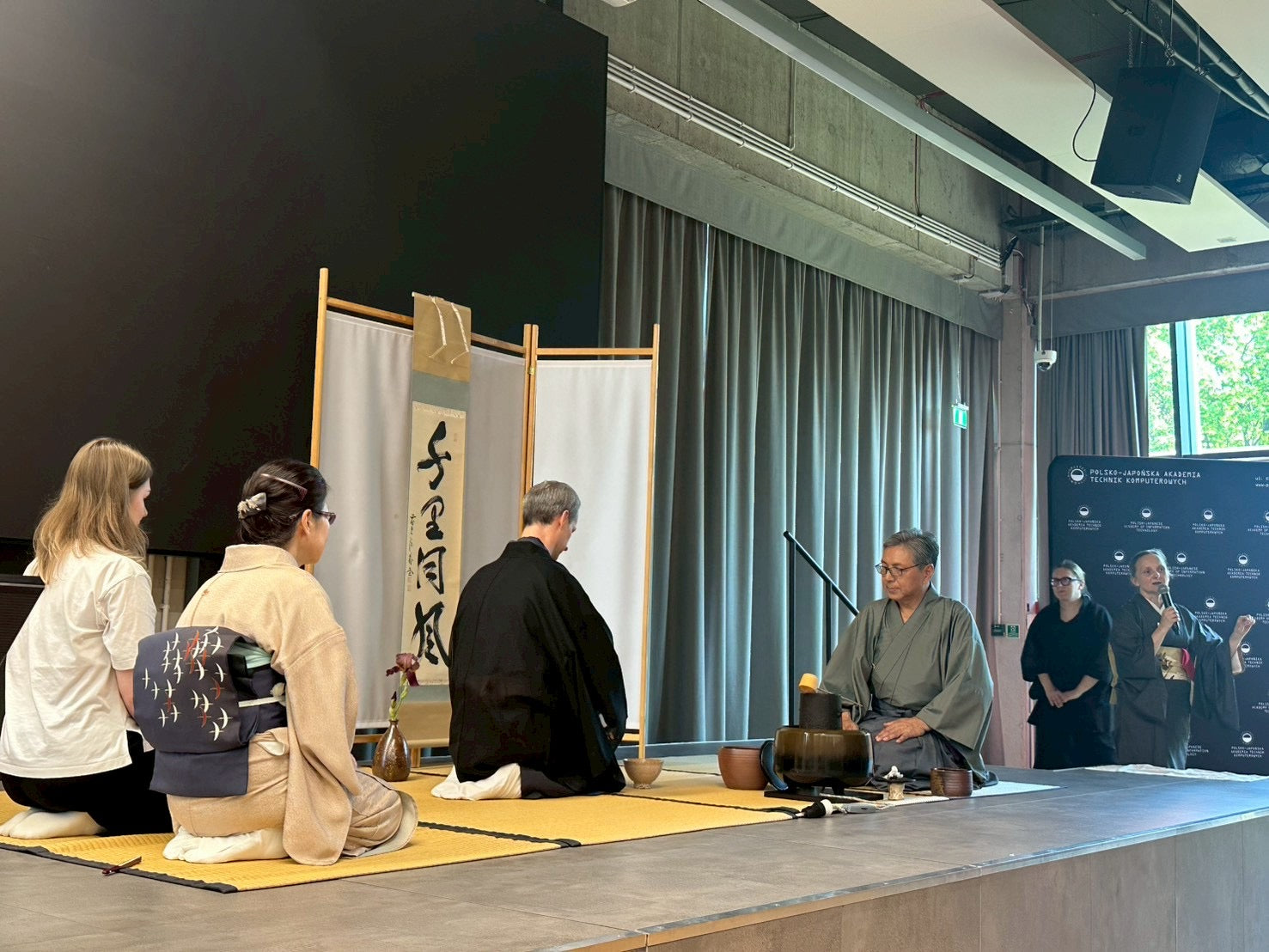
Tea gathering at Polish-Japanese Academy of Information Technology (PJAIT)
The Architecture of "Boundaries" Leading to the Tea Room
Tamada: A traditional tea room features a garden path called a "Roji." Guests travel through outer and inner gardens before reaching the tea room itself. Along this path, various "Kekkai" (sacred boundaries) are set. By bowing low to pass through the small crawling-in entrance ("Nijiriguchi"), guests intentionally leave behind worldly status and daily distractions.
Once you understand the narrative and philosophy behind the entire experience, each individual movement connects meaningfully, revealing the true depth of tea culture.

"Kaian" Tea Room at the University of Warsaw
(To be continued in Part 2)
Toshiro Tamada
Born in Fukushima Prefecture in 1957.
Graduated from Tokyo Zokei University (Department of Design) and completed his Master's degree in Industrial Design at the Graduate School of Art and Design, University of Tsukuba.
After working at the Tokyo Metropolitan Industrial Technology Research Institute, serving as an Associate Professor at Tohoku University of Art & Design, and as a Visiting Professor at the University of Art and Design Helsinki (now Aalto University), he joined Tokyo Zokei University in 2006. His fields of expertise are Industrial Design and Design Management, actively leading regional industry production and design research and development.
He served as Vice President of Tokyo Zokei University from 2014 to 2018 and was named Professor Emeritus in 2023. In 2020, he founded the Japan Design Management Association (JDMA) and serves as its Representative Director.
He is also an Associate Professor in the Omotesenke Domonkai tea school, holding the tea name Tamada Soshun.
His publication credits include Regional Design: Lessons from the 'Climats' of Burgundy, France (Co-authored / Gendaikikakushitsu, 2018), ICONIC WORLD (Tohoshuppan, 2020), Indicators of Design Management and the Founding of the Japan Design Management Association (The Industrial Craft Foundation / Japan Crafts & Technology Association, 2023), 7 Indicators of Design Management: DESIGN DYNAMISM (Japan Design Management Association), and A Journey Through Ancient Visual Culture: Primitive Landscapes and Icons of Faith (Text by Toshiro Tamada, Photography by Kazuto Nakazato and Mao Matsuda / FUIGOLAND LLC, Sold by JDMA, 2024; collected in the Miwayama Library of Omiwa Shrine).

%20has%20long%20hosted%20creative...)